
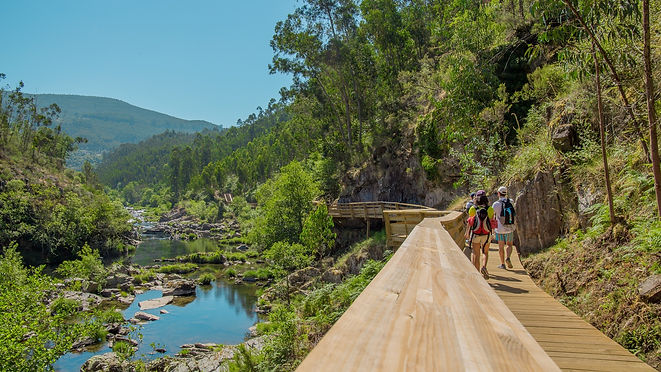
PAIVA WALKWAYS
Paiva Walkways: A Unique Nature Experience
The Paiva walkways are located on the left bank of the Paiva River, in the municipality of Arouca, within the UNESCO-classified Arouca Geopark. This route, officially opened in June 2015, currently has a linear length of 8.7 km and offers a unique opportunity for direct contact with nature, biodiversity, and the geology of one of the richest regions in Portugal. Among the plant species, it is possible to observe trees such as alders, willows, ash trees, and oaks, which make up the rich riverside vegetation. The fauna is also diverse, with mammals such as the fox, the hedgehog, the wild boar, and the wild rabbit, in addition to notable aquatic and semi-aquatic species, such as the water vole, the otter, and the water lizard. In the aquatic ecosystem, the Lusitanian salamander, the Iberian frog, the marbled newt, the Iberian barbel, and the river mussel stand out. Regarding geodiversity, visitors can marvel at emblematic geosites such as the Aguieiras Waterfall, the Paiva Gorge, the Gola do Salto, the Vau River Beach, and the Espiunca Fault, which further enrich the natural experience.
When to visit:
The Paiva Walkways are open year-round, revealing different aspects of their natural beauty as the seasons change. Spring and autumn are especially recommended, with mild temperatures that make walks more pleasant, and the mountains take on a spectacle of vibrant colors. During the winter, it is important to be prepared for adverse conditions, such as rain and cold, which are common at this time of year. In the summer, it is advisable to do the route in the early morning or late afternoon to avoid the intense heat, which can be quite scorching throughout the day.
The Route:
The Paiva Walkways route extends between the Areinho river beach and Espiunca, passing through several important geosites and biosites, such as the Paiva Gorge, the Aguieiras Waterfall, and the Espiunca Fault. The walk crosses stunning landscapes, including river beaches, rock formations, and forests. The difficulty of the route is considered high, with steep inclines, and the complete walk takes an average of 2h30 to 3 hours, depending on the pace. In addition, during the route, visitors can swim in the crystal-clear waters of the Paiva River in designated areas and take breaks at leisure and picnic spots, such as the Vau River Beach.
How to Get There:
The Paiva Walkways are about an hour's drive from the cities of Porto, Aveiro, and Viseu, accessible via the N225 or A32 roads.
Espiunca:
If you choose to start the Paiva Walkways route from Espiunca, you will have an easier route at the beginning and a more intense one at the end, as you will find the Paiva Walkways staircase almost at the end of the route. Next to the parking lot you will find a support bar and restrooms, and the entrance to the Paiva walkways is approximately 100 meters away.
Public Park: Google Maps Link: https://g.co/kgs/By25LZZ Route Start: GPS Coordinates: 40°59'34.67"N 8°12'41.19"W Route Start: Google Maps Link: https://g.co/kgs/hwVAQK7
Vau Beach:
Along the way you'll find Vau Beach, a great river beach for swimming and enjoying nature. This beach has restrooms and is a connection point for taxis and transfers. Vau River Beach, Google Maps Link: https://maps.app.goo.gl/jNpkDNAuyB27kGuL6
Areinho:
If you choose to start the Paiva walkways route from Areinho, you will opt for a more difficult route at the beginning and a gentler one at the end, as you will find the Paiva walkways staircase practically at the start of the route. If you enter from the Areinho river beach, there is a parking lot, a support bar, and restrooms right at the beginning of the trail. This parking lot usually fills up quickly, so there is another nearby parking lot called Parking Lot 516 Arouca - Pórtico Areinho. This parking lot is about 5/10 minutes away from the entrance. Note: the pedestrian path from Parking Lot 516 Arouca - Pórtico Areinho to the start of the route is sometimes not in the best condition. Don't take risks; if the path is not in good condition, opt to take the route to the beginning of the Paiva walkways along the edge of the R326 asphalt road, ideally driving facing oncoming traffic.
Route start: GPS Coordinates: 40°57'10.6"N 8°10'36.6"W Route start: Google Maps link: https://maps.app.goo.gl/WUA4z2hrxB9b6EhA9
Parking 516 Arouca - Pórtico Areinho: Google Maps link: https://g.co/kgs/S7XnFkp Round Trip Route: If you choose to do the round trip, we suggest starting the walk in Espiunca. This way you will pass the Paiva walkway staircase halfway through, and avoid having to climb the stairs at the end of the walk.
Alternative Route:
As we have already explained, the biggest physical challenge of the Paiva walkways is the staircases near Bridge 516. Starting the route from the Areinho entrance, you will have to climb 310 steps at the beginning of the walk; starting from the Espiunca entrance, you will have to climb 450 steps at the end of the route.
If you have someone in your group with mobility difficulties, there is an alternative. You can do the Paiva walkways in the Areinho – Espiunca direction, but instead of starting at the entrance, on the Areinho river beach, you can choose to start the Paiva walkways next to Bridge 516, accessing the bridge through a forest access.
To do this, you should choose to leave your car at Parking Lot 516 Arouca - Pórtico Areinho, and then instead of going down to the Areinho river beach to start the route, you can go up the R326 road to a forest access that takes you directly to the entrance of bridge 516, at the top of the stairs.
If you do this, and continue the route towards Espiunca, you will only have to go down the 450 steps of the staircase. Naturally, if the intention is to do the round trip, you will have to go up at the end.
Parking Lot 516 Arouca - Pórtico Areinho: Google Maps Link: https://g.co/kgs/S7XnFkp
Direct access road to bridge 516 Arouca: Google Maps Link: https://maps.app.goo.gl/jXyQoEyx5JNFGNG98
Practical Information:
Opening Hours:
The Paiva walkways are open year-round, with hours varying depending on the time of year.
The Paiva walkways open between 8:00 AM and 9:00 AM, and the last entry allowed may be between 3:00 PM and 5:00 PM. The Paiva walkways close between 7:00 PM and 8:00 PM.
Before planning your walk, visit the official website to confirm the opening hours for the days you plan to walk and purchase your tickets.
Parking:
There is free parking at the Espiunca and Areinho entrances, but it is not supervised.
Type of route: Linear, starts in Espiunca and ends in Areinho or vice versa.
Transfers: Transfer services are available for those who do not want to do the round trip. At the end of this page you will find links with various contacts.
Running is not allowed on the Paiva Walkways, nor is cycling or any type of motorized vehicle.
Services: At the ends and in the middle of the route, there are restrooms and trash cans. In case of emergency, there are strategically located SOS phones.
Recommendations:
Equipment: Comfortable clothing and footwear, sunscreen, water (at least 1 liter per person) and a hat on hot days are recommended.
Reservations:
Reservations can be made online, and cancellations are not allowed, but it is possible to reschedule the visit up to two days in advance for a fee. Find the link to the official website in the useful links at the end of this page.
Arouca Geopark:
A Geological and Natural Treasure
The Arouca Geopark is a protected area in northern Portugal, recognized as a UNESCO Global Geopark since 2009. Covering approximately 328 km², the geopark is part of the global network of geoparks that aims to preserve and promote geodiversity, local culture, and sustainable education. Within the Arouca Geopark, there are more than 40 geosites, including the iconic Paiva Walkways, the 516 Arouca Bridge, and fascinating geological phenomena such as the "Parturient Stones" and the giant trilobites of Canelas.
What is a Geopark?
A UNESCO Global Geopark is an area with geological heritage of international significance. The main objective is to promote sustainable tourism and geoscientific education, connecting geology with other aspects of the region's natural and cultural heritage. To be designated as a Geopark, an area must demonstrate a commitment to geological conservation, sustainable development, and the involvement of local communities.
UNESCO Global Geoparks have a "bottom-up" approach, meaning they are driven by the community itself, in collaboration with local and regional authorities. Currently, there are 213 Global Geoparks spread across 48 countries around the world. These parks not only preserve geological heritage but also create new economic opportunities, primarily through geotourism (UNESCO).
What are Geosites?
Geosites are sites of notable geological importance where geological features and processes are preserved and displayed for study, education, and tourism. These sites can be rock formations, fossils, tectonic faults, or other phenomena that tell the geological story of an area. In geoparks like the Arouca Geopark, geosites are fundamental for education about geodiversity and attract visitors interested in geology, geotourism, and environmental conservation.
Geosites of the Paiva Walkways:
The geosites along the Paiva Walkways are part of an impressive set of geological formations, sculpted over millions of years by natural forces, mainly by the action of water and tectonics. Each geosite has its own unique geological history, reflecting past events that shaped the landscape of the Arouca Geopark.
Paiva Gorge (G36)
Location: https://maps.app.goo.gl/BjZ3rPfvARLg8DYD9
The Paiva Gorge is a deep gorge formation, the result of intense erosive processes over millions of years. This gorge was shaped by fluvial erosion caused by the Paiva River, which, over thousands of years, cut through the rocks, sculpting the steep walls of the valley. The predominant rock in this area is granite, an intrusive igneous rock that solidified deep within the Earth's crust during the Hercynian Period (about 300 million years ago). Fractures created by tectonic movements allowed the continuous action of water, deepening the gorge and exposing layers of sedimentary rocks.
Aguieiras Waterfall (G35)
Location: https://maps.app.goo.gl/WJEujdx9utgxpo8x8
Aguieiras Waterfall is a spectacular waterfall that occurs over a granite rock formation. Waterfalls generally form where there are variations in the resistance of the rocks along the riverbed, and in the case of Aguieiras Waterfall, the water carves its path through the granite, an extremely hard rock.
Vau River Beach (G30)
Location: https://maps.app.goo.gl/GSsoJuMG6Q7CCLhBA
Vau River Beach is a serene and relaxing spot, but it's also a remarkable example of how rivers deposit sediment over time, forming river beaches. River beaches are formed in places where the river's speed decreases, allowing sediment (sand, gravel, and other fine materials) to be deposited on the banks.
Gola do Salto (G31)
Location: https://maps.app.goo.gl/dyorLG1NyiVevtEX8
Gola do Salto is a point where the river passes through a narrow gorge, creating a series of dramatic rapids. This geosites is marked by the intensity of the Paiva River's current, which has carved deep into the granite formations. The name "Gola do Salto" (Leap Gorge) derives from the force with which the water "leaps" between the rocks, creating a narrow and powerful passage.
Espiunca Fault (G32)
Location: https://maps.app.goo.gl/RMrLvTxpX2otBq6T9
The Espiunca Fault is one of the most interesting geological points of the Paiva Walkways, where it is possible to observe an exposed tectonic fault. Faults are fractures in the Earth's crust that occur due to movements of tectonic plates, resulting in the displacement of rocks on both sides of the fault.
What are Biosites?
Biosites are locations of significant importance for the conservation of biodiversity. These locations have ecosystems, habitats, and species that deserve special protection due to their ecological relevance or risk of extinction. In general, a biosite is an area where there is a notable concentration of flora and fauna species, often unique or endangered, and that contribute to the ecological sustainability of a region.
On the Paiva Walkways, integrated into the Arouca Geopark, biodiversity plays a crucial role. Along the 8.7 km route, visitors have the opportunity to explore several biosites that are home to an impressive variety of species, some of them threatened, and which depend on continuous protection to ensure their survival.
Biosite B1 – Dragonflies (Odonata)
In Biosite B1, the highlight is the dragonflies that inhabit the Paiva River. Here, several species can be observed, such as the Macromia (Macromia splendens), one of the most emblematic dragonflies in Europe and an Iberian endemic. Other protected dragonflies, such as the Emerald Dragonfly (Oxygastra curtisii) and the Gomphus (various species of the genus Gomphus), can also be seen. These dragonflies are important indicators of water quality, as they depend on clean aquatic environments to survive.
Biosite B2 – Endangered Species and Rarities of Paiva
This biosite is dedicated to the observation of endangered species and rarities of the region. Highlights include the Aurinia butterfly (Euphydryas aurinia), a protected species of caterpillar that feeds on honeysuckle, and the Quadripuntária (Euplagia quadripunctaria), a nocturnal diurnal butterfly that flies between July and September. Both species are listed in Annex II of the European Union Habitats Directive.
Biosite B3 – Insects and Beetles
At Biosite B3, visitors can observe a diversity of insects, especially beetles, such as the Tiger Beetle (Cicindela campestris), famous for being a fast runner, and the Spring Beetle, which jumps as if it had a spring in its body. Butterflies are also noteworthy, such as the Green Butterfly (Pontia daplidice), a common diurnal butterfly in the region.
Biosite B4 – Riparian Forest and Ferns
Biosite B4 is an area where the riparian forest is well preserved, with species such as the Royal Fern (Osmunda regalis) and the Maidenhair Fern (Asplenium trichomanes). These ferns are found in humid and shaded areas along the riverbanks. In addition, it is possible to observe insects such as mayflies, ancient insects whose nymphal stage is aquatic.
Biosite B5 – Calopteryces (Demoiseles)
Biosite B5 offers an opportunity to observe the three species of Calopteryces that occur in Portugal: the Western Calopteryx (Calopteryx xanthostoma), the Blue Calopteryx (Calopteryx virgo), and the Black Calopteryx (Calopteryx haemorrhoidalis). These dragonflies are identified by the vibrant colors of their wings and can be seen flying along the riverbanks.
Biosite B6 – Large Butterflies and Their Host Plants
In this biosite, large butterflies can be observed, such as the Strawberry Tree Butterfly (Charaxes jasius) and the Lemon Butterfly (Gonepteryx rhamni), both associated with their host plants, such as the strawberry tree and the buckthorn. In addition, the Pandora Butterfly (Argynnis pandora) is frequently seen on the wild violets of the region.
Biosite B7 – Mediterranean Shrubs and Metaconglomerates
At Biosite B7, visitors will find typical species of Mediterranean shrubs, such as the Carqueja (Pterospartum tridentatum) and the Arboreal Heather (Erica arborea). In addition, this biosite is notable for its metaconglomerates, rocks formed by fragments of quartz and quartzite, which are visible along the path.
Biosite B8 – Biodiversity in Rocks
Biosite B8 is dedicated to observing organisms that live in rocks, such as fungi, lichens, and mosses. Among the highlighted species are the Red Clathrus (Clathrus ruber), a saprophytic fungus, and the Five-Spotted Tent Spider (Uroctea durandi), which makes its thick silk web under the rocks.
Biosite B9 – Willows and Butterflies
The last biosite highlights the importance of willows, trees typical of riverbanks, and three species of butterflies whose caterpillars feed on the leaves of these trees: the Little Apatura (Apatura ilia), the Antiopa (Nymphalis antiopa), and the Polychloros (Nymphalis polychloros). This biosite also allows the observation of fault mirrors, polished surfaces in rocks resulting from movement between blocks of rock.
These biosites provide a rich environmental education experience, allowing visitors to explore the unique biodiversity of the Paiva River while appreciating the region's natural beauty.
The Importance of the Arouca Geopark
The Arouca Geopark stands out for its geological diversity, with formations dating back to the Ordovician period, more than 450 million years ago. One of the most fascinating geosites is the giant trilobites, fossils found in Canelas that can reach up to 90 cm. Another unique phenomenon is that of the "Parturient Stones," where small nodules of biotite detach from the granite rock, a rare phenomenon that attracts geotourists and scholars from all over the world.
In addition to geology, the Arouca Geopark is also a place for education and recreation. The park offers hiking trails, rafting, geological interpretation centers, educational programs, and visitor support infrastructure that values sustainable tourism and environmental preservation.
This unique combination of geodiversity, local culture, and sustainable tourism opportunities makes the Arouca Geopark an unmissable destination, attracting thousands of visitors annually.
Useful Links:
Conditions, schedules and ticket reservations on the official page: https://passadicosdopaiva.pt/
Transfers: https://passadicosdopaivatransfers.pt/
Taxis:
https://www.facebook.com/Passadicosdopaivataxi/?locale=pt_PT
https://ponte516arouca.com/servicos/taxis-arouca/
Other:
http://aroucageopark.pt/
https://www.cm-arouca.pt/
http://www.tagis.pt/
https://florestas.pt/
https://www.europeangeoparks.org/
Important note: The information presented on this page should be considered only as suggestions, aimed at making the experience on the Paiva walkways easier and more enjoyable for Aldeia da Margarida's clients. At the time of writing this article, GPS and Google Maps points refer to existing access routes in good condition. However, please note that changes may be made at any time by the competent authorities, or the access conditions and the route itself may have deteriorated due to fires, rain, wind, or other natural or human-caused factors. For this reason, before following any of our suggestions, we recommend that you contact the competent authorities through the available means (websites, emails, and telephone) to verify that both the Paiva walkways and the access routes we have mentioned are in good condition and that it is safe to undertake the route you have planned, on the day and time you have planned. Aldeia da Margarida is not responsible for the conditions in which you will find the Paiva walkways or any of the accesses suggested here. It is your sole responsibility to assess these conditions and take appropriate safety measures.
FAQs
How long does it take to do the Paiva walkways?
The route takes on average about 2h30 to 3h (one way only).
How many steps are there on the Paiva walkways?
The climb is much greater when doing the route in the Espiunca-Areinho direction, where you will find 450 steps at the end of the route. If you do the route in the opposite direction, you will only find 310 at the beginning of the walk.
How many km are the Paiva walkways?
The Paiva walkways are located on the left bank of the Paiva River, in the municipality of Arouca, district of Aveiro, and are 8.7 km long with a rest area halfway along Vau beach.
How to buy Paiva Walkways tickets?
You can buy tickets online at https://passadicosdopaiva.pt/.
You can also buy directly on-site, but the price is approximately double.
Remember that reservations are mandatory and, if capacity is at its limit, it is not possible to buy tickets on-site. Therefore, don't make a wasted trip and buy your tickets now through the official Paiva Walkways reservation center.
How much does it cost to go to the Paiva Walkways?
Ticket prices range from € 0 for children up to 10 years old to € 2 for adults if the ticket is purchased online or R$ 4 per adult if the ticket is purchased on-site.
Is bridge 516 part of the Paiva walkways?
No, bridge 516 is not a mandatory part of the Paiva walkways. To access bridge 516 you have to buy a separate ticket. However, if you intend to visit the 516 bridge, keep in mind that the bridge ticket may also grant access to the Paiva walkways, but never the other way around. Therefore, if you intend to visit the bridge, buy the bridge ticket beforehand and confirm whether or not it grants access to the Paiva walkways on the same day.
What are the Paiva walkways for?
Before becoming a popular trend, walkways were primarily designed as a practical solution to reduce the environmental impact of people passing through sensitive areas. In addition, they helped to circumvent natural obstacles, such as small watercourses or marshy areas. For this reason, the first walkways in Portugal were installed in coastal and dune areas, where the preservation of fragile ecosystems was a priority.
Where to eat near the Paiva Walkways?
The Paiva walkways have restaurants at the beginning and end of the walkways. However, there are several restaurants nearby such as:
Casa do Areinho Ltda.
Aldeia da Margarida is not responsible for the conditions in which you will find the Paiva walkways or any of the accesses suggested here. It is your sole responsibility to assess these conditions and take appropriate safety measures.
Where to eat near the Paiva Walkways?
The Paiva walkways have restaurants at the beginning and end of the walkways. However, there are several restaurants nearby such as:
Casa do Areinho Ltda.
Mota Restaurant.
Paiva à Vista Restaurant.
Decio Restaurant.
Pedestrian walkway 142.
Parliament.
Dona Amélia Restaurant.
Tasquinha da Fazenda.
What to visit near the Paiva Walkways?
Canoeing and abseiling excursions.
Ecological trails.
Cross the 516 Arouca suspension bridge.
Visit the trilobite museum.